Introduction
Many companies underestimate the importance of a clearly structured customs department.
A lack of organization quickly leads to errors in classification, export licenses, or proofs of preference.
However, an efficient customs department can also be easily integrated into medium-sized companies – provided it is properly positioned.
Position in the Organizational Chart
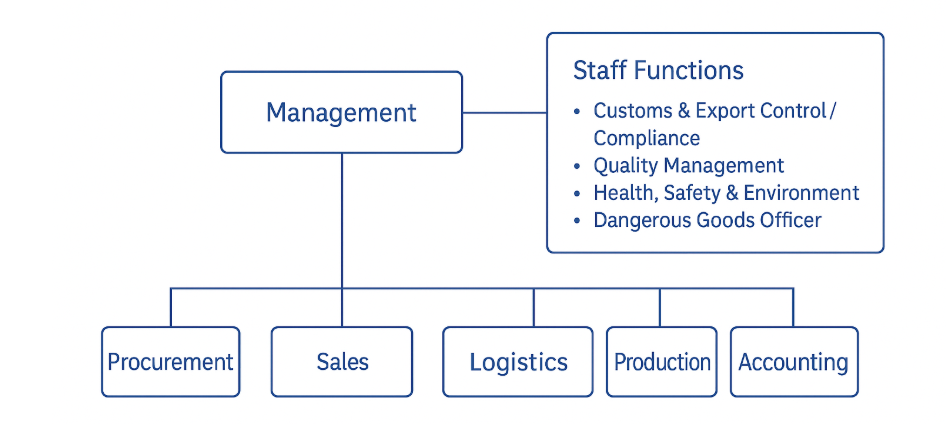
The customs department should not simply be part of logistics or accounting,
but should be established as a staff unit directly reporting to management.
This ensures that customs and export control decisions are made independently and in compliance with legal requirements.
Example of an Organizational Structure:
The following illustration shows how the customs department can be optimally integrated as a staff unit:
Main Tasks of the Customs Department
1️⃣ Customs Tariffing and Classification
- Determination of the correct customs tariff numbers
- Maintenance of the product database and interfaces to the ERP system
2️⃣ Export Control and Authorizations
- Verification of goods for dual-use, embargoes, and country sanctions
- Preparation and management of BAFA applications
- Implementation of the internal export control system (ICS)
3️⃣ Sanctions List Screening
- Automated screening of business partners (customers, suppliers, employees)
- Documentation of approval processes and hit analyses
4️⃣ Preferential Law & Origin Management
- Preparation of supplier declarations and proofs of origin
- Monitoring of preference calculations
- Communication with customers and suppliers regarding preference inquiries
5️⃣ Procedure Management & Communication
- Management of authorizations (AEO, Authorized Exporter, etc.)
- Point of contact for the main customs office and internal departments
Secondary Tasks & Supporting Activities
- Training and awareness programs for employees
- Internal audits and risk analyses
- Maintenance of product data, country codes, and customs information in the ERP system
- Preparation of reports for management and the compliance department
Typical Mistakes in Practice
– Customs department integrated into accounting (“because that’s where the documents are”)
– No clear substitution or backup regulations
– Lack of communication between sales, purchasing, and the customs office
– Missing master data maintenance and inconsistency in tariff classification
Conclusion
A clearly structured customs department is not only a legal requirement but also a competitive advantage.
It reduces risks, accelerates processes, and strengthens corporate legal compliance.
Those who understand customs, export control, and compliance as strategic functions lay the foundation for sustainable international success.